IPPOG Resources Portal
The « resources portal » was created in 2025 by IPPOG, the international collaboration for outreach and science communication in particle physics, at the request of the high-energy physics community.
It serves as a showcase highlighting the community's outreach and science-communication projects.
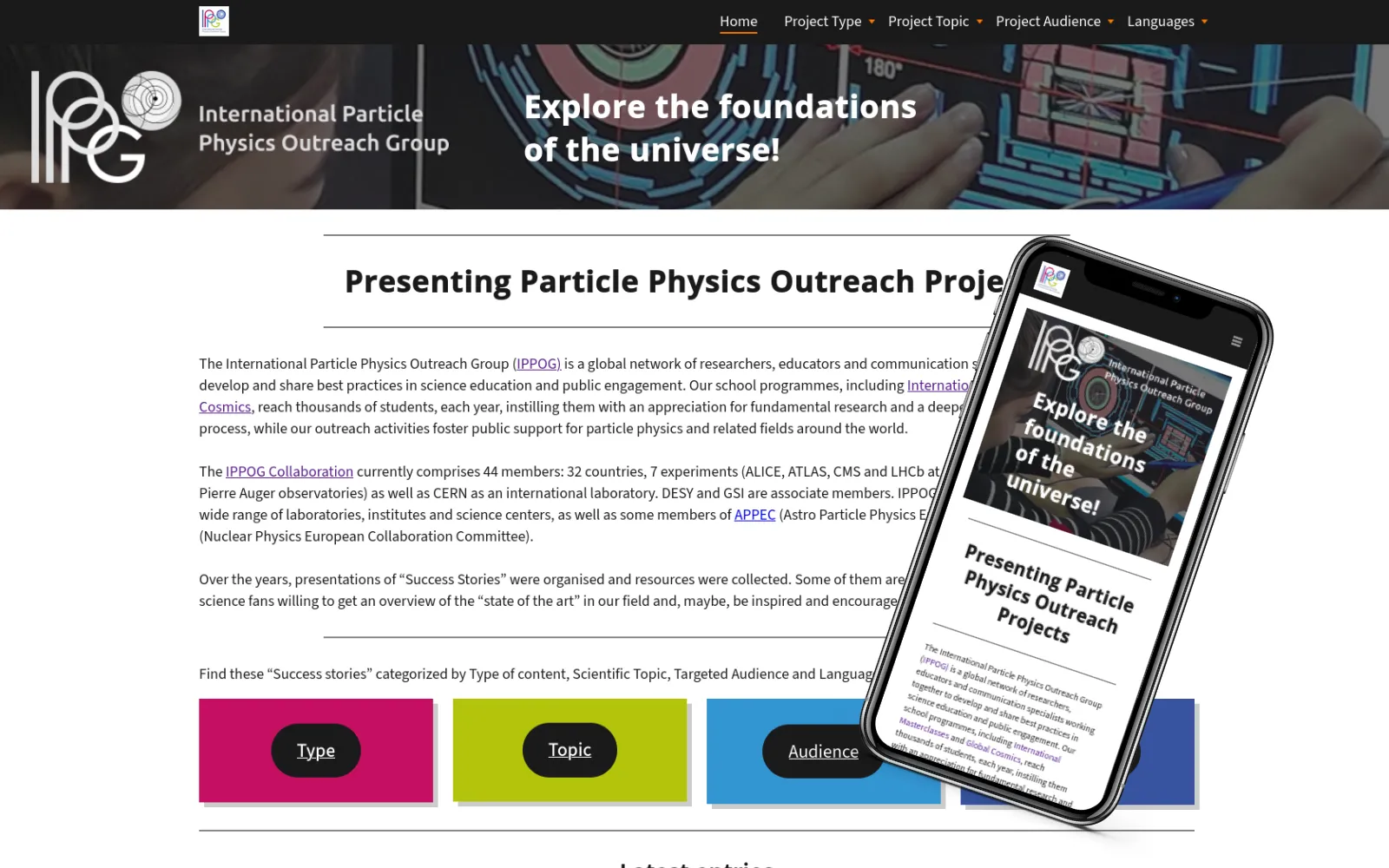
Context & Objectives
The portal was developed as part of a 5-month administrative student contract carried out at CERN in 2025. As part of this project, I was responsible for assisting Claire Adams, who was in charge of curating public outreach resources.
The development of the portal was part of an effort to test CERN’s new web infrastructure. In fact, CERN management decided to gradually migrate its web infrastructure from Drupal to WordPress.
The portal’s goals are twofold:
- To provide a platform where people interested in getting involved in public outreach can find ideas,
- To serve as a showcase highlighting the community’s commitment and efforts in public outreach.
Previously, public outreach projects were presented at the IPPOG collaboration’s biannual meetings and were only available as PDFs on the conference management tool Indico.
Role & Responsibilities
- Defining a simple yet effective taxonomy to classify projects
- Structuring the website
- Collaborating with the IT team in charge of CERN's WordPress
- Publishing a first batch of projects and automating the process
- Attending collaboration meetings and presenting the project's progress
- Writing a technical document describing how the portal works
Process / Implementation
Building a database of the projects presented at the semi-annual meetings over 2019–2025, and identifying the key information to highlight.
After a benchmark analysis, the old site's taxonomy was reworked into a tree of 4 meta-categories (Types, Topics, Language, Audience) split into 25 categories, then 50 tags for finer searches.
Structuring the site and echoing the collaboration's visual identity.
Developing an automated publishing process from the database: a Google form feeds the database, a Python script processes it (locally or via the Google API) and generates a ready-formatted Markdown document per project, which simply needs to be pasted into a new page. Everything is available on a Git repository.
Presented at the 29th IPPOG collaboration meeting.